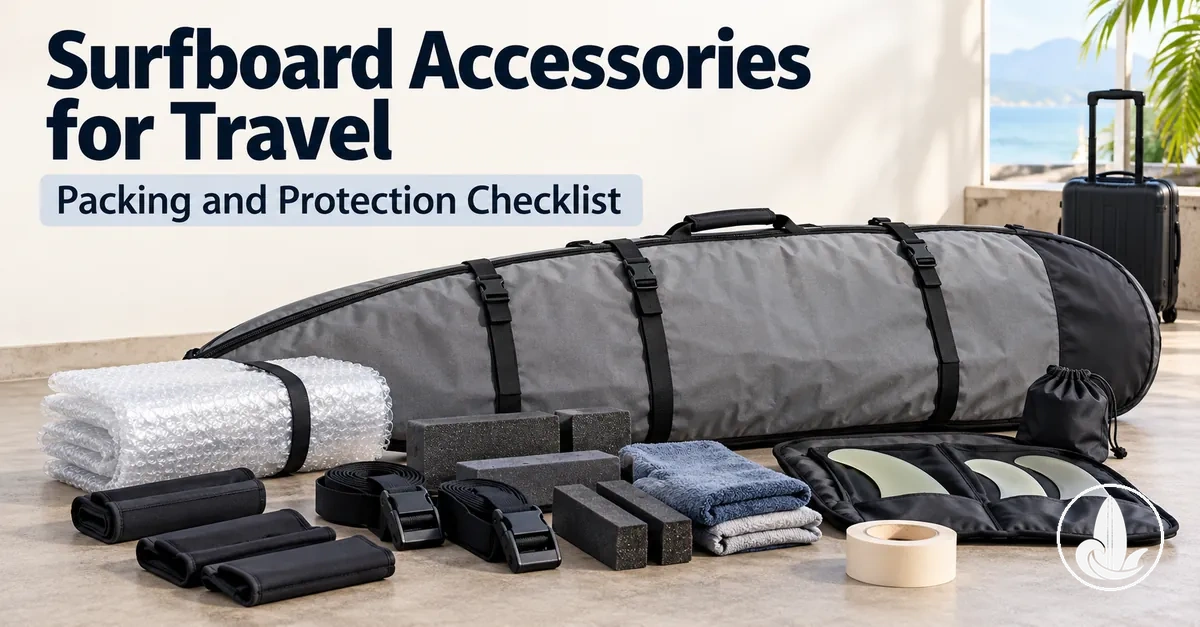
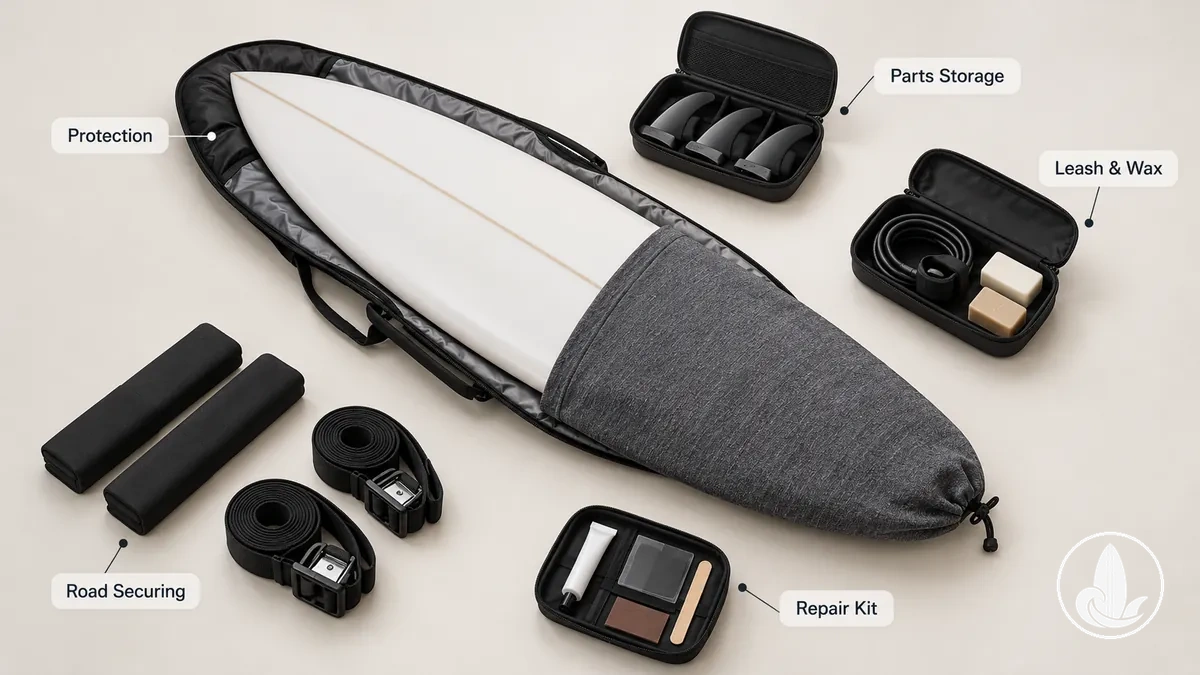
For surfboard travel, use a well-fitted protective bag or cover, isolate removable fins and other hard parts, add cushioning where the nose, tail, rails or fin-box area are exposed, and keep the packed load from shifting freely. Air travel prioritises enclosed protection and carrier-specific baggage checks, while road travel prioritises padded contact and secure tie-downs matched to the vehicle and rack setup.
Travel protection decision map
Match the packing setup to the transport condition. The aim is to control impact exposure, loose hard parts and unwanted movement before any product choice.
Every trip
Protect + contain + stabilise. Use a board-fitting outer layer, separate hard or messy accessories, and check that the closed load does not shift freely.
Air travel
Prioritise a padded travel bag, vulnerable-area cushioning and contained removable parts. Verify the actual carrier's size, weight, acceptance and fee conditions for the itinerary.
Road travel on a rack
Use padded contact points and tie-downs suited to the rack and vehicle. Keep hard buckles off the board surface and secure loose strap tails.
Multiple boards
Add board-to-board separation as well as accessory separation so movement does not create direct contact between boards.
Minor repair readiness
Carry compact repair supplies only when they are compatible with the board and suitable for the intended minor repair; structural damage needs a fuller repair assessment.
No packing setup eliminates transport risk; it reduces avoidable movement, abrasion and concentrated contact.
This checklist covers surfboard protection, removable-part containment, transport securing and minor repair readiness. Clothing, documents and other general travel gear are outside its scope.
Table of Contents⌄
Surfboard Accessories to Pack for Travel
Pack by function rather than by item count: protect the board, contain removable or messy accessories, add transport securing where the carrying method requires it, and bring only board-compatible supplies for minor repair readiness.
A travel bag, board sock or padding provides the protection layer; fins, leash, wax and small hardware need containment; rack pads and tie-down straps are conditional on the road-carrying setup; and a repair kit is conditional on the board and the repair material's stated compatibility.
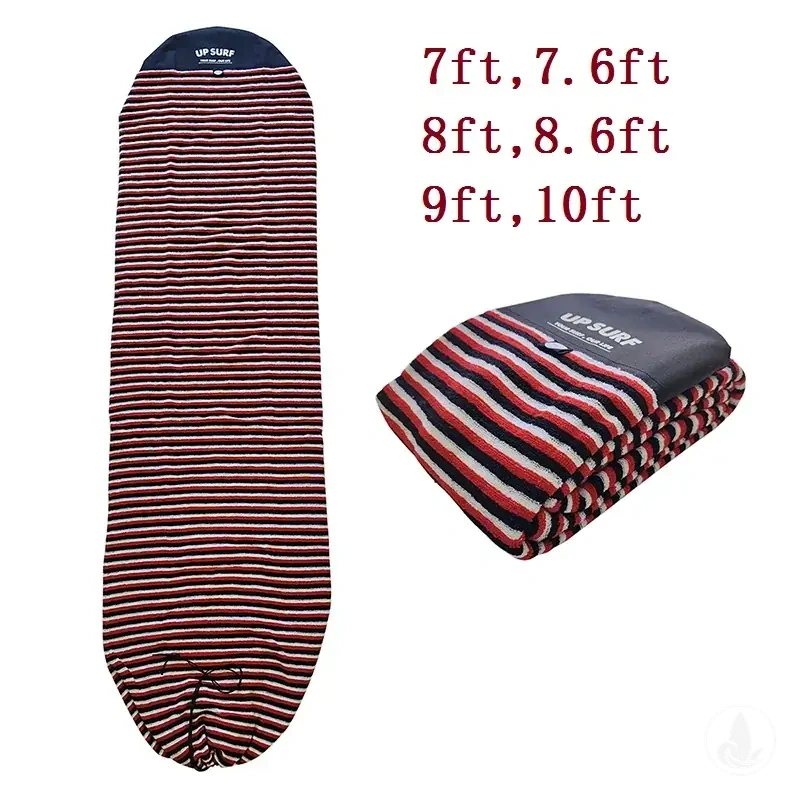
Travel bag, board sock or padding: choose the protection layer according to board fit, bag capacity and expected handling exposure.
Fin case or storage pouch: useful when fins are removable; it keeps hard fins and related small parts separated from the board.
Leash and wax: keep them contained with the travel set so they do not move loose around the board; wax is best isolated in a closed container.
Rack pads: road-travel equipment for a compatible rack setup where padded contact is needed.
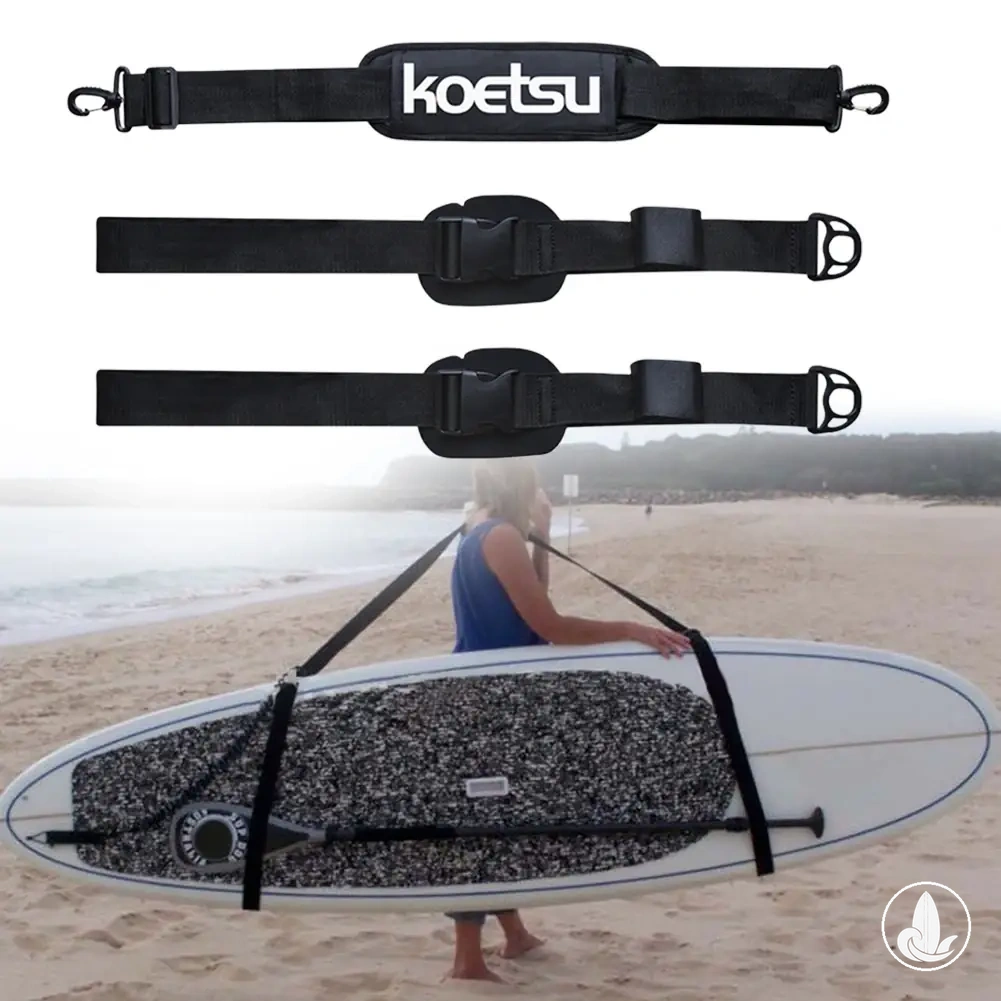
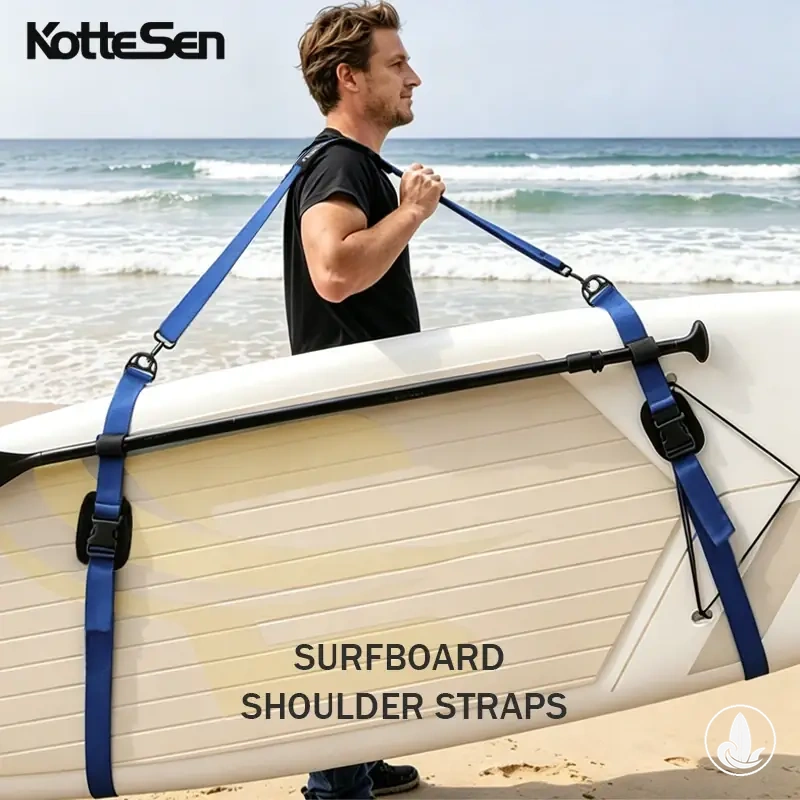
Tie-down straps: road-travel securing equipment when the carrying setup requires the board to be restrained externally.
Repair kit: include it only for minor repair tasks and only when the repair material is compatible with the board.
Selection rule: air travel emphasises enclosed protection and removable-part containment; road travel emphasises the securing method when the board is carried on a rack or other external carrying system.
Travel Bag, Board Sock, and Protective Padding
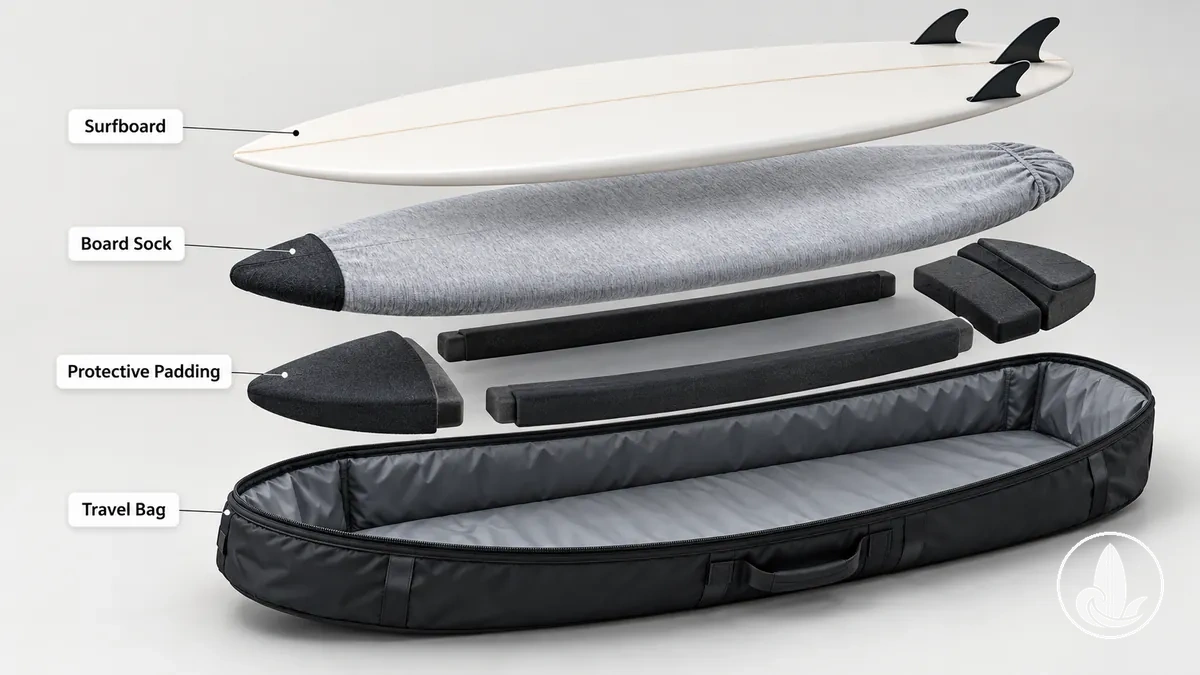
A travel bag, a board sock and local padding perform different protection jobs. A padded travel bag is the main outer enclosure, a board sock mainly separates the board surface from surrounding gear, and supplemental padding adds cushioning at exposed contact zones.
Travel bag
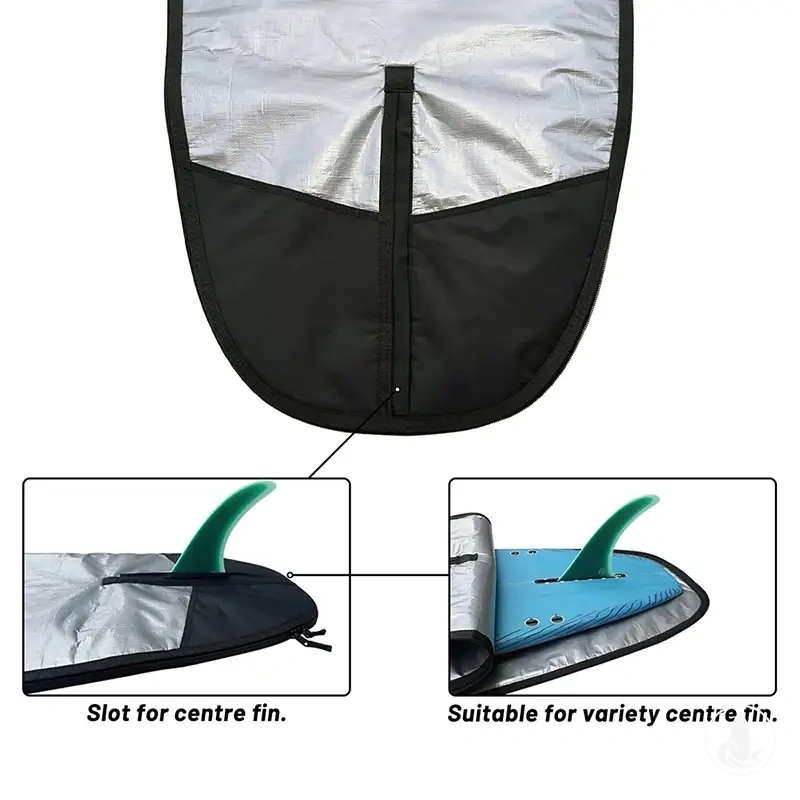
Primary role: padded outer enclosure for transit. Fit and construction matter because excessive internal space can allow the board to move.
Board sock
Primary role: surface separation that can reduce rubbing, abrasion and wax transfer. It is not equivalent to a padded travel bag for higher impact exposure.
Local padding
Primary role: extra cushioning at vulnerable areas such as the nose, tail, rails or fin-box zone when the packed arrangement creates concentrated contact.
Choose the combination that fits the board securely, keeps the protective layers in position and matches the expected handling exposure. Extra padding should supplement a suitable bag, not compensate for a poor fit or uncontrolled internal movement.
Fins, Leashes, Wax, and Small-Part Storage
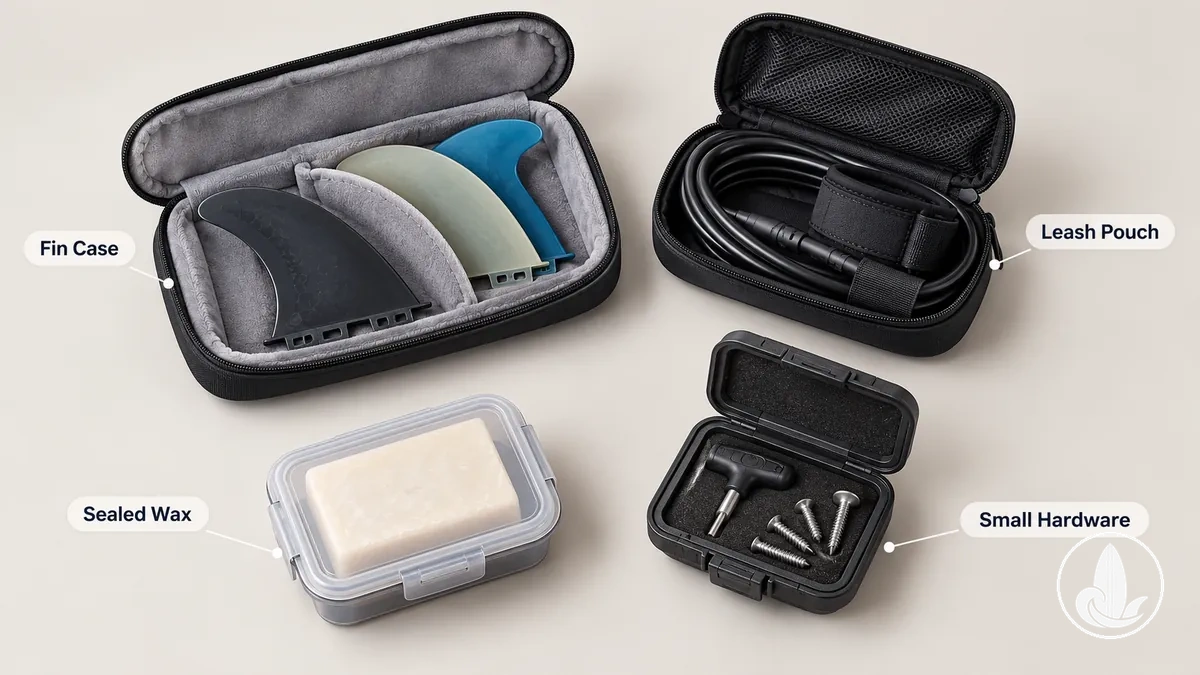
Loose hard parts, small hardware and wax create different travel risks, so containment should match the item: hard parts need separation, small parts need loss control, and wax needs residue containment.
Removable fins
Padded fin case or compartment — keeps hard fin surfaces away from the board and reduces loss risk.
Leash
Storage pouch — keeps the coiled leash from moving freely around the board and other accessories.
Wax
Closed container — isolates wax and residue from fabrics, the bag interior and other equipment.
Fin key, screws and small hardware
Closed small-parts compartment — keeps related parts together and prevents loose hard contact.
For air travel, the applicable carrier and security rules determine where fins and other accessories may be packed; do not assume one airline or jurisdiction's treatment applies to another.
Travel Repair Supplies and Basic Tools
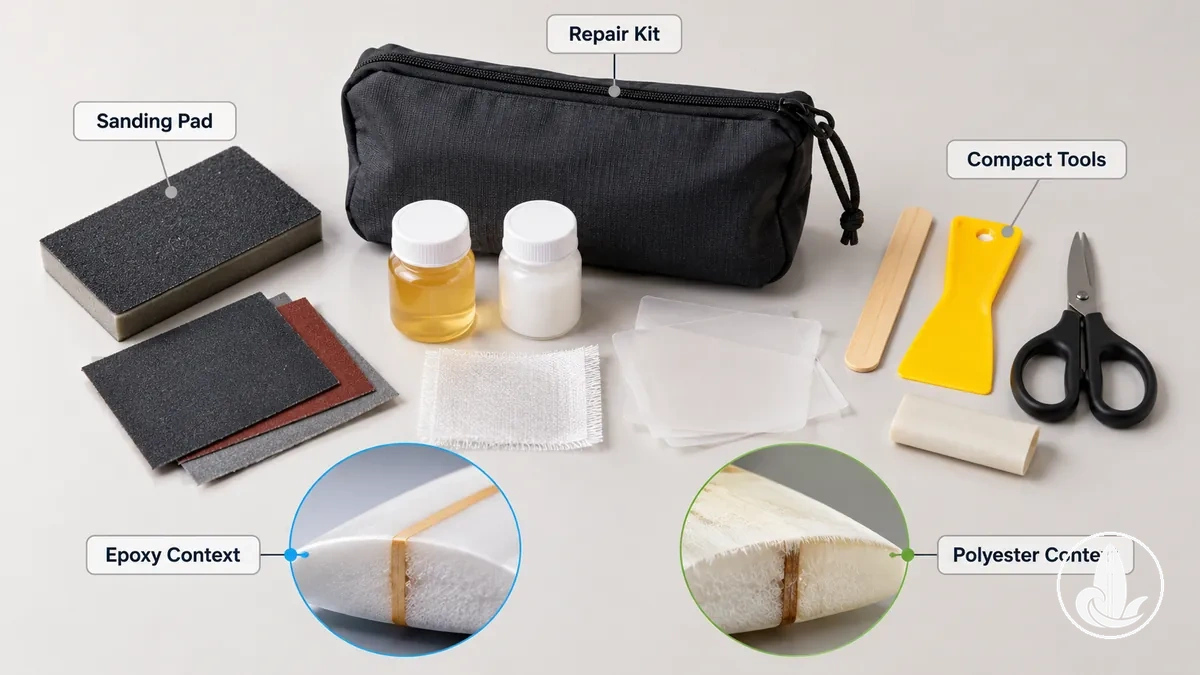
A travel repair kit is for minor, temporary repair readiness, not for structural repair. Useful contents can include board-compatible repair or patch material, a sanding pad and a compact applicator or basic tool.
Repair material
Use only material whose stated compatibility matches the board construction; do not assume epoxy and polyester repair contexts are interchangeable.
Preparation
A sanding pad can support surface preparation or smoothing for a minor repair when the repair instructions call for it.
Application
A compact applicator or basic tool is sufficient only for the limited repair task the kit is designed to handle.
Boundary
Structural damage or damage beyond the kit's intended scope needs a fuller repair assessment rather than a travel-kit fix.
Air-travel check: if the kit contains a liquid or chemical repair product, verify the carrier and baggage restrictions that apply to that specific material and itinerary before travel.
Pack Surfboard Accessories to Prevent Movement and Impact Damage
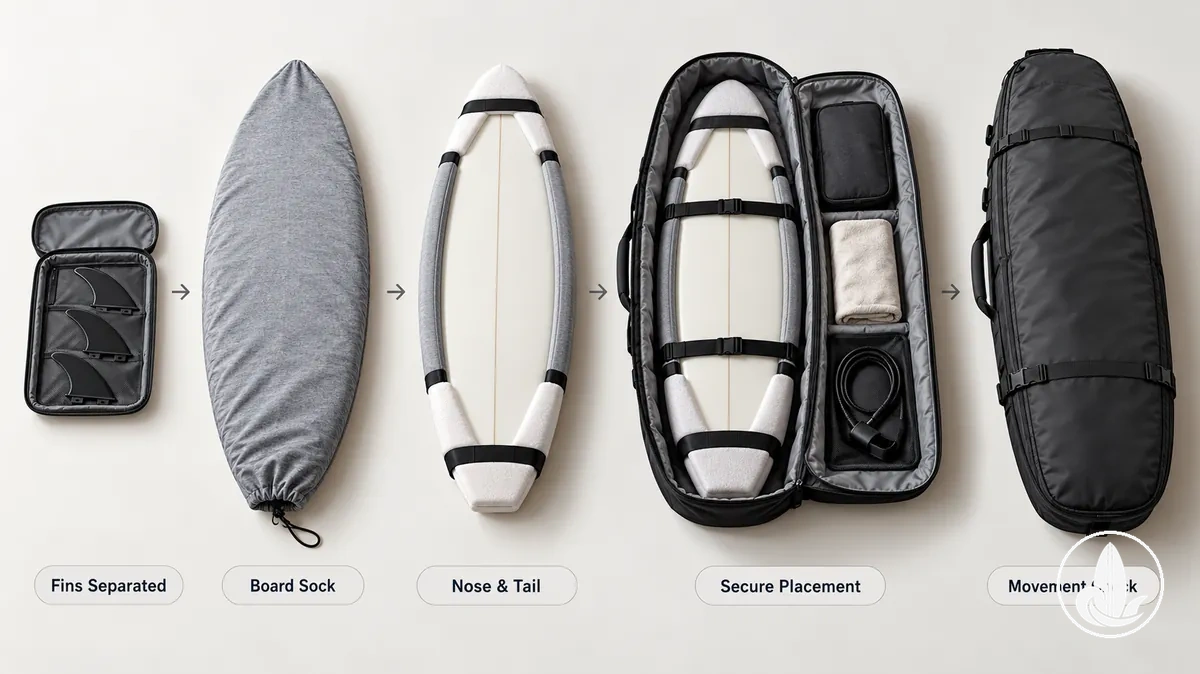
Pack by removing detachable hard parts, separating loose accessories from the board, adding protection at exposed areas and stabilising the load without forcing concentrated pressure onto the surfboard.
Clear and inspect the travel bag: start with the packing area free of loose hard objects that could sit against the surfboard, and check the bag interior before placing the board inside.
Remove detachable hard parts: remove fins and separate them from the board; contain the fins, leash hardware and other hard or loose accessories so they cannot move freely against the surfboard.
Contain small accessories: place small parts in a closed pouch or compartment rather than distributing them loosely around the board, reducing direct hard-part contact during travel.
Add protective layers: place the board in a board sock or suitable protective layer and use padding around vulnerable areas such as the nose, tail and rails where added cushioning can reduce concentrated impact exposure.
Arrange and separate the board: centre a single board within the travel bag; when packing multiple boards, maintain protective separation between them so board-to-board contact does not become an additional contact risk.
Stabilise without overpacking: arrange contained accessories and protective layers so they limit internal movement while avoiding tightly concentrated loads against the board, because excessive packing pressure can create another point of stress.
Close and check: close the travel bag without forcing the closure, then check whether the board or contained accessories can shift noticeably inside; if they do, adjust their placement or protective separation before travel.
The objective is movement control, not maximum compression. A secure pack limits hard-part contact and board movement while allowing the bag to close normally without creating unnecessary pressure points.
Separate Removable Parts and Contain Small Accessories
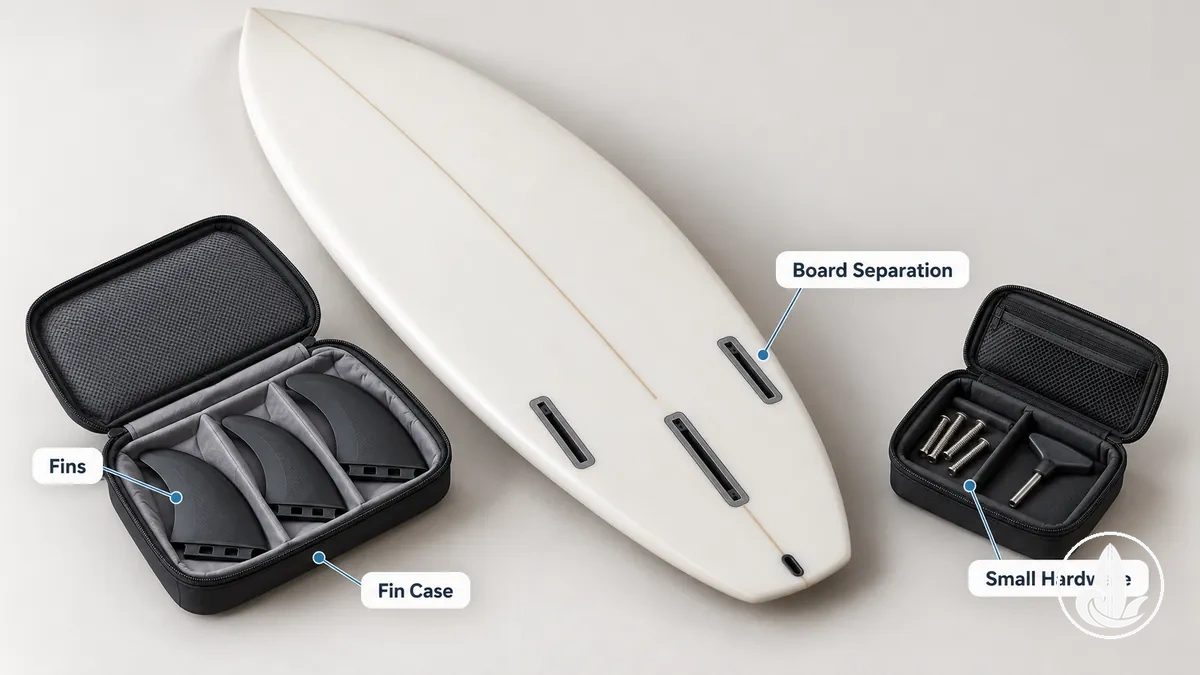
Removable fins, screws and a fin key are hard items that can scratch or press against the surfboard when left loose. Remove them before packing where the board uses removable fins, then keep the parts contained and separated from the board surface.
Remove the fins: place removable fins in a fin case or padded compartment, then check that the case keeps the hard fin surfaces separated from the board.
Contain the small hardware: place screws and the fin key in a closed compartment or accessory pouch so the hardware cannot move loose inside the luggage.
Position the contained parts: keep the closed fin case and small-parts pouch away from direct contact with the board surface.
Check for movement: confirm that each case or pouch remains closed and cannot shift freely into contact with the surfboard.
Add Protection Around Vulnerable Board Areas
Local protection should match the likely contact type: use cushioning where concentrated impact is plausible and use surface separation where repeated rubbing is the main concern.
Nose and tail
Main exposure: concentrated end impacts. Add local cushioning where the packed arrangement leaves either end exposed.
Rails
Main exposure: rubbing and surface contact. Use a protective layer or separation to reduce abrasion.
Fin-box area
Main exposure: hard contact from nearby packed items. Keep hard accessories away and add local padding when the arrangement creates a pressure point.
Between multiple boards
Main exposure: board-to-board contact. Maintain a separation layer so movement does not make the boards rub or strike each other directly.
Padding and protective layers reduce abrasion and impact exposure; they do not make a packed surfboard damage-proof.
Adapt Surfboard Protection to Air and Road Travel
Air and road travel create different protection priorities. Air travel reduces your control after check-in, so enclosed padding, removable-part containment and internal movement control matter most; road travel keeps the carrying setup under more direct control, so stable securing and padded contact become central.
Travel method
Handling control
Primary securing method
Main movement risk
Removable-part treatment
Protection emphasis
Air travel
External baggage handling limits direct control after check-in.
Travel bag closure and stable internal placement.
Board or packed items shifting inside the travel bag during handling.
Contain removable parts such as fins and small hardware separately from the board surface.
Travel-bag protection, padding at exposed areas, separation and control of internal movement.
Road travel
Handling and placement remain more directly controlled through the vehicle carrying setup.
Rack or carrying-system securing, using rack pads and tie-down straps when required by the setup.
Board movement against the rack, carrying surface, other boards or contained equipment.
Contain removable parts when they could move against the board or become loose during transport.
Stable securing, contact separation and padding where the carrying arrangement creates pressure or contact points.
Travel method establishes the protection priority, not a universal packing configuration. Board count, rack type, vehicle setup and carrier conditions can add further requirements.
Air Travel with Bag Protection and Removable-Part Storage
For air travel, control the conditions you can set before check-in: bag closure, internal movement, removable-part containment and vulnerable-area padding. Size, weight, acceptance and fees are carrier-specific rather than fixed values for every itinerary.
Bag closure: the packed bag should close normally without a forced closure or an obvious concentrated pressure point against the board.
Internal movement: the board and contained accessories should not shift freely inside the travel bag.
Removable fins: place them in a fin case or padded compartment away from the board surface.
Vulnerable areas: position padding where the nose, tail, rails or fin-box area remain exposed to concentrated contact in the packed arrangement.
Carrier conditions: verify the actual carrier's size, weight, acceptance, fee and baggage-treatment rules for the itinerary before travel.
Do not transfer one airline's conditions to another. A bag accepted on one itinerary may be handled differently by another carrier or route.
Road Travel with Rack Pads and Secure Tie-Downs
For road travel on a rack, the secure setup is the one that matches the actual vehicle, rack, securing points and board load. Rack pads provide padded contact; tie-down straps restrain the board; and hard buckles or loose strap tails should not become new contact hazards.
Verify padded contact: keep rack pads between the surfboard and the relevant hard rack contact points.
Verify strap routing: route the tie-downs according to the actual rack type and vehicle setup rather than assuming one path fits every system.
Verify suitable tension: the loaded board should remain stable in position without assuming that more tension is always better for every board, rack or vehicle.
Verify buckle position: keep the hard buckle away from direct board contact or maintain suitable protection between them.
Secure loose strap tails: contain excess strap length so it does not move freely around the board or vehicle.
Recheck the loaded setup before departure and after any loading change. Use observable stability rather than a universal strap-tension value.
Pre-Departure Checks for Packed Surfboard Accessories
A pre-departure check should find anything loose, exposed, missing, incompatible or unverified before the surfboard enters transit. Correct a failed check before departure rather than treating the pack as ready.
Bag closure — pass: the travel bag closes normally and remains closed; fail: the closure is open, forced or obstructed by the packed contents.
Padding — pass: the intended padding remains positioned around the protected areas; fail: padding is displaced or leaves an intended contact area exposed.
Internal movement — pass: the board and contained accessories do not shift freely inside the closed bag; fail: a loose item or contained group can move freely against the board.
Removable parts — pass: fins and other removable parts remain contained in their pouch, case or compartment; fail: a hard part is loose, missing from its containment or in direct contact with the board surface.
Repair kit — pass: the required board-compatible repair supplies are present and contained for the intended minor repair role; fail: a required item is missing, loose or unsuitable for the board.
Road securing — pass: where the board is carried on a rack setup, the tie-down straps remain secured and the loaded board remains positioned on padded supports; fail: a strap, buckle, loose strap tail or board position requires correction.
Air-travel constraints — pass: the packed board has been checked against the actual carrier conditions for size, weight and acceptance; fail: an applicable condition remains unverified for the itinerary.
The setup is ready only when the observable checks pass and the applicable carrier or vehicle requirements are satisfied.
The products below are examples for comparing travel-protection and carrying options against those criteria.