
Surfboard Protection Accessories for Damage Prevention
Choose surfboard protection by matching the accessory to the board’s dominant exposure: padded bags for plausible knocks and dings, board socks or light covers for scratches, dust and lower-contact handling, and rack or strap contact-point padding plus secure tie-downs for transport. Fit and coverage must keep protection over exposed areas, and no accessory eliminates heat, compression, concentrated pressure or poor-securement risk.
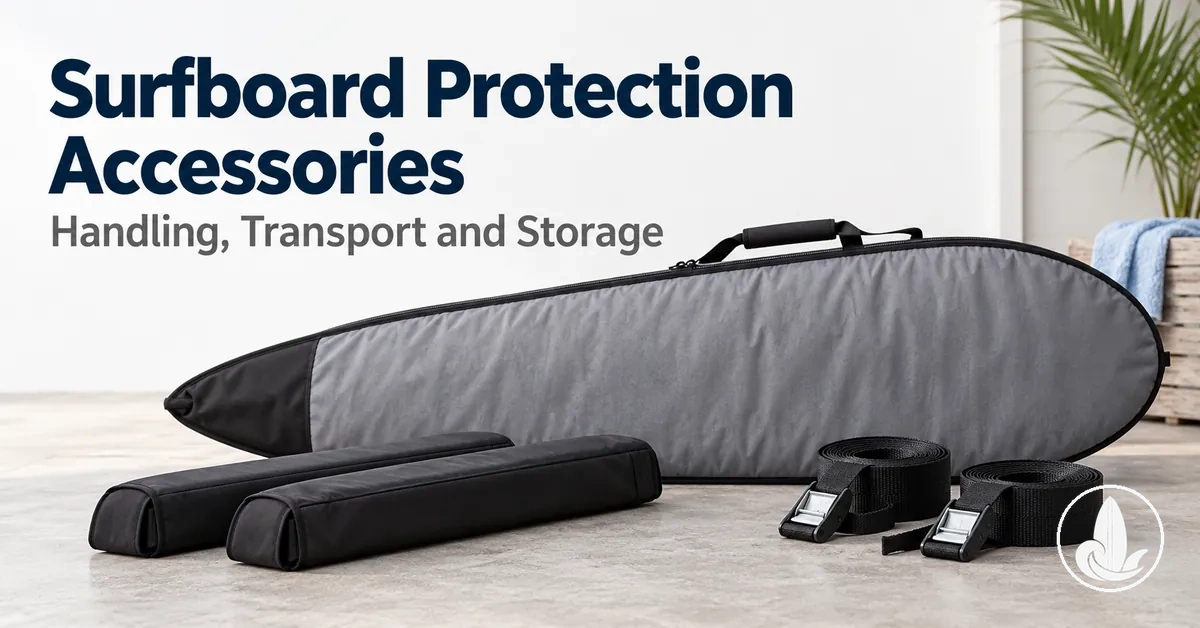
Match protection to the dominant risk
Start with the main exposure, then check fit, coverage and securement. Combine protection types when the board faces more than one risk.
Scratches, dust and light contact
- Useful profile
- Well-fitted board sock or lightweight cover
- Prioritise
- Surface coverage and fit
- Trade-off
- Less impact-oriented cushioning than a padded bag
Knocks, dings and harder contact
- Useful profile
- Padded surfboard bag; add local rail, nose or tail protection where impact is concentrated
- Prioritise
- Cushioning over likely impact zones
- Trade-off
- More bulk, without removing heat or compression risk
Rack, strap and transport contact
- Useful profile
- Rack pads, protected strap contact points and secure tie-downs
- Prioritise
- Pressure distribution, separation from hard hardware and restraint
- Trade-off
- Padding cushions contact; securement controls movement—neither replaces the other
Storage, dust, sunlight and sustained support
- Useful profile
- Fitted cover or board sock, with contact-point cushioning where the board rests on supports
- Prioritise
- Coverage, material suitability and support condition
- Limit
- Reduce ambient heat exposure directly; do not rely on a cover or padded bag to control temperature
Decision rule: choose the setup that provides the cushioning, coverage, fit and securement required by the board’s actual exposure; use added bulk only when it supplies a protection function the use case needs.
Use the risk the board is most likely to face as the starting point, then verify the relevant protection attributes in the detailed sections below.
Table of Contents
Damage Risks Surfboard Protection Accessories Can Reduce
Surfboard protection accessories reduce risk by interrupting specific damage mechanisms: abrasion, local impact, hard contact, concentrated pressure, unwanted movement and environmental exposure. They reduce exposure; they do not make a surfboard damage-proof.
Routine handling is more likely to emphasise rubbing and minor knocks; transport can add rack contact, strap compression and movement; storage can add sustained contact, dust, heat and UV exposure. The required protective function changes with the exposure.
The illustration maps the main risk zones, while the list below pairs each damage mechanism with the protection function that addresses it.

- Scratches and abrasion: rubbing against rough or hard surfaces can mark the board surface; suitable coverage provides a barrier that reduces direct surface contact.
- Dings and local impact: knocks to the nose, rail, tail, or other exposed areas can cause local damage; padding or cushioning can reduce the force transferred at the contact point.
- Hard contact: contact with racks, walls, floors, or other boards can concentrate force on exposed areas; padding at the contact interface can reduce direct hard-surface contact.
- Contact pressure and compression: rack contact or strap loading can place concentrated or sustained pressure on the surfboard; cushioning and appropriate securement can spread contact across a broader area and reduce pressure concentration.
- Heat and UV exposure: prolonged transport or storage exposure can subject the surfboard to heat and sunlight; suitable coverage or reduced direct exposure can limit these environmental risks, with effectiveness depending on the cover and exposure conditions.
- Poor securement: movement during transport can allow repeated contact, shifting, or impact; secure restraint can reduce unwanted movement while avoiding unnecessary concentrated pressure on the board.
Full-Board, Edge and Contact-Point Protection
Protection scope can be full-board, edge-focused or contact-point specific. Full-board coverage separates broad surfaces from surrounding contact; edge protection concentrates on the rails, nose and tail; contact-point protection cushions where racks, straps or other hard surfaces meet the board.
The useful scope follows where force or rubbing is expected: broad surface exposure favours board-wide coverage, local knocks favour targeted guards, and rack or strap contact favours padding at the contact interface.
The diagram shows those spatial relationships; the structured summary below explains the protection role of each scope.

- Full-board protection: bags, socks, and covers provide broad coverage across the surfboard surface when much of the board may contact surrounding objects; this coverage can reduce direct rubbing, abrasion, and minor impact where the fit, material, and padding suit the exposure.
- Edge protection: local guards or padded coverage focus on the rail, nose, or tail when those exposed edges are more likely to receive a knock or concentrated impact; suitable cushioning can reduce direct contact and the force transferred to the protected area.
- Contact-point protection: rack pads and padded areas beneath straps focus protection where racks or straps meet the surfboard during securement; suitable cushioning can reduce hard contact, abrasion, and concentrated pressure when its position and padding match the contact area.
Padded Bags, Board Socks and Covers for Full-Board Coverage
A padded surfboard bag combines full-board coverage with cushioning, so it is the stronger profile when minor impacts and dings are plausible. A board sock or lightweight cover mainly provides a barrier against scratches, dust and routine surface contact, with less bulk and less impact-oriented cushioning.
UV shielding depends on the material and how completely the board is covered; none of these options should be treated as a way to control ambient heat.
Choose by the exposure: use more cushioning when knocks are plausible, and favour lighter coverage when surface protection is the main need. Fit matters in either case because loose or incomplete coverage can shift or leave high-contact areas exposed.

- Padding: a padded surfboard bag adds cushioning where minor impact and dings are plausible during transport, while a board sock or lighter surfboard cover primarily separates the board surface from surrounding contact rather than providing the same impact-oriented cushioning.
- Surface coverage: a padded surfboard bag, board sock, or surfboard cover can shield covered surfaces from direct contact; the degree of protection against scratches, dust, or wax transfer depends on which areas remain covered and on the covering material.
- Fit: each type provides its intended coverage when its fit keeps the protective material over the relevant surfboard surfaces; loose or incomplete coverage can leave areas exposed or allow the material to shift.
- Bulk: a padded surfboard bag carries the additional bulk associated with cushioning, while a board sock or lightweight surfboard cover uses a lighter covering where surface protection rather than impact cushioning is the main requirement.
- Exposure protection: a board sock or surfboard cover can reduce direct exposure to dust, scratches, and UV when its material and coverage suit those conditions, while a padded surfboard bag combines surface coverage with cushioning where contact and minor impact are also concerns.
Rail, Nose and Tail Guards for Local Impact Protection
Rail, nose and tail guards provide targeted protection where impact or repeated rubbing is concentrated on an edge or end rather than across the whole board.
Their useful attributes are coverage, cushioning, abrasion resistance and fit. Cushioning addresses impact; abrasion-resistant material addresses rubbing; fit keeps the protective layer over the exposed zone.
Use local guards as supplementary protection when the rails, nose or tail remain likely contact points even with broader board coverage.

- Rail protection: coverage along the edge can provide an abrasion-resistant contact layer where repeated rubbing or edge contact could otherwise contribute to scratches, chips, or local surface wear; its protective effect depends on material, coverage, fit, and the contact involved.
- Nose guard: local coverage and cushioning around the nose can reduce direct contact at this exposed end when an impact creates a risk of dings or chips; the likely effect depends on fit, cushioning, coverage, and impact force.
- Tail guard: local coverage and cushioning around the tail can reduce direct end contact associated with dings, chips, or abrasion; the likely effect depends on fit, material, coverage, and the force or rubbing involved.
Rack Pads and Protected Strap Contact Points
Rack pads cushion board-to-rack contact; protected strap contact points cushion where straps or hardware bear on the board; tie-down straps perform the separate job of securement by limiting movement.
These functions should not be confused: padding can reduce hard contact, abrasion and pressure concentration, but it does not restrain the board. Securement can limit movement, but it does not automatically cushion buckle, strap or rack contact.
Check the actual contact path—rack bar, strap line and buckle or hardware position—so padding sits where pressure occurs and restraint limits unwanted shifting without creating unnecessary concentrated pressure.

- Rack surface: rack pads place padding between the surfboard and rack bar; where their coverage and fit match the board-to-rack contact area, they can reduce hard-surface contact, concentrated pressure, and abrasion.
- Strap contact: where tie-down straps cross the board, a protected contact area can distribute strap pressure across the covered surface and reduce direct rubbing; the effect depends on strap material, tension, contact area, and board movement.
- Buckle contact: where a buckle or other hard hardware bears against the surfboard, separation or suitable padding at that contact point can reduce direct hard contact and the associated risk of scratches or local pressure marks.
- Board movement: securement from tie-down straps restrains movement rather than providing cushioning; when restraint limits shifting at padded contact points, it can also reduce repeated rubbing between the board and rack surfaces.
Protection Level: Padding, Fit, Coverage and Durability
Evaluate a protection setup through padding, fit, coverage, durability and contact conditions, not padding thickness alone.
Padding matters where impact or pressure occurs; fit keeps the protection positioned; coverage determines which areas are shielded; durability determines whether materials, seams, closures and contact surfaces remain serviceable under repeated use.
More padding is not automatically more suitable if the protection shifts, leaves high-contact zones exposed or introduces hard contact points. Likewise, broad coverage has limited value if it does not stay over the surfaces that need it.
The illustration and table turn those attributes into checks that can be applied to a specific handling, transport or storage context.

| Protection attribute | Condition to check | Why it matters | Decision signal |
|---|---|---|---|
| Padding | Cushioning is positioned at areas likely to receive impact, hard contact, or concentrated pressure. | Padding can reduce direct hard-surface contact and cushion local impact, with the protective effect determined by its material, placement, and the contact involved. | Prioritise appropriate cushioning where impact or pressure is plausible rather than selecting padding by apparent thickness alone. |
| Fit | The protective layer sits securely around the board without obvious looseness or shifting that exposes intended protection zones. | A secure fit helps keep padding and protective material positioned over the intended contact areas. | Visible looseness or movement that exposes a high-contact zone reduces suitability for that use condition. |
| Coverage | High-contact areas expected for the intended use remain covered by the protective layer. | Coverage determines which board surfaces receive the intended cushioning or barrier against abrasion and contact. | An exposed high-contact zone indicates that supplementary or differently positioned coverage may be needed. |
| Durability | Materials, seams, and protective surfaces remain serviceable under the expected repeated loading, rubbing, and exposure. | Wear can reduce cushioning, coverage, or resistance to abrasion over time, with the rate determined by material, exposure, and use conditions. | Visible wear, weakened seams, or degraded contact surfaces indicate reduced continued suitability. |
| Closures or contact surfaces | Closures remain functional and hard or abrasive contact surfaces do not bear directly against vulnerable board areas. | Closure position and contact-surface condition can affect pressure, securement, rubbing, and local abrasion. | Prefer configurations where closures remain secure and potentially abrasive or hard contact points are separated from the board surface. |
| Exposure conditions | The setup matches the expected combination of impact, pressure, abrasion, repeated loading, and environmental exposure. | The demands on padding, fit, coverage, and durability change with the type and frequency of contact and exposure. | Match the combined protection attributes to the dominant exposure rather than treating one configuration as suitable for every condition. |
Prioritise the combination of attributes that matches the dominant exposure. A setup with moderate cushioning but reliable fit and coverage can be more appropriate than a bulkier option that shifts or leaves critical contact zones exposed.
Inspect materials, seams, closures and protective contact surfaces as they wear; visible damage or loss of positioning is a practical signal to repair, replace or reconfigure the protection rather than relying on its original condition.
Padded Bags vs Board Socks for Impact and Surface Protection
A padded bag generally suits greater impact exposure because its cushioning reduces direct hard contact associated with dings, while a board sock emphasises lighter surface protection against scratches with less bulk.
Either option can reduce dust and direct UV exposure only to the extent that its material, fit and coverage are suitable; a board sock does not provide the same impact-oriented cushioning as a padded bag.
The key trade-off is more cushioning and bulk versus lighter, lower-bulk surface protection.
| Criterion | Padded bag | Board sock | Decision implication |
|---|---|---|---|
| Impact cushioning | Padding provides cushioning where knocks and hard contact create a risk of dings. | Light fabric coverage provides less impact-oriented cushioning against harder contact. | Favour a padded bag when impact protection is a primary requirement. |
| Scratch or surface protection | Covered surfaces are separated from surrounding objects, while padding adds cushioning against contact. | Fabric coverage provides a lighter barrier against scratches and routine rubbing. | A board sock can suit lower-contact handling when surface protection is the main need. |
| UV or dust shielding | Coverage can shield the board from dust and direct UV exposure according to the bag material and how completely the board is enclosed. | Coverage can shield against dust and UV according to the sock material, fit, and the areas covered. | Check material and coverage rather than assuming either option provides the same environmental shielding. |
| Bulk | Padding creates a bulkier protective layer around the surfboard. | Light fabric creates a lower-bulk covering. | Lower bulk favours a board sock where impact cushioning is not the main requirement. |
| Fit tolerance | Suitability depends on a fit that keeps padding and coverage positioned over the intended areas. | Suitability depends on a fit that keeps the fabric over the board without leaving intended protection areas exposed. | Choose the option whose fit maintains the required protection over the relevant contact zones. |
| Typical use context | Better suited where travel or storage involves greater potential for knocks and hard contact. | Better suited to short trips or storage where surface exposure is the main concern and hard impacts are less likely. | Match the protection type to the expected contact and exposure rather than treating either option as a universal choice. |
For short trips or storage with limited hard contact, a well-fitted board sock can provide lower-bulk surface protection against scratches and dust, and may reduce direct UV exposure when its material and coverage are suitable.
Where transport or storage involves plausible knocks or harder contact, a padded bag’s cushioning has greater value. In either case, fit and the board’s actual exposure should govern the choice.
Matching Protection to Handling, Transport and Storage Risk
The appropriate protection level follows the expected risk during handling, transport or storage rather than an accessory label.
Light-contact handling emphasises surface coverage and fit. Plausible impact or compression increases the importance of cushioning, secure fit and protected contact points; sustained dust or UV exposure increases the value of suitable coverage, while heat exposure should be reduced at the environment rather than delegated to the cover.
Use the checks below to match exposure type, intensity and duration to the protection attributes that matter.
- Handling contact: verify how often the surfboard is likely to rub against or touch surrounding surfaces; repeated light contact increases the importance of coverage that separates vulnerable surfaces from scratches and abrasion.
- Impact likelihood: verify whether transport or handling is likely to involve knocks or hard contact; where impact is plausible, padding and cushioning at exposed areas become more important for reducing exposure to dings.
- Compression: verify whether racks, straps, stacking, or other contact can apply concentrated or sustained pressure; where compression is plausible, prioritise padding, fit, and contact protection that keep cushioning positioned at the pressure areas.
- Heat and UV exposure: verify whether the surfboard will spend time in direct sunlight or heat during transport or storage; as the intensity or duration of this exposure increases, suitable environmental coverage becomes more important.
- Exposure duration: verify whether contact or environmental exposure is brief or prolonged; longer exposure increases the importance of maintaining suitable coverage, fit, and material condition throughout that use period.
- Fit and coverage: verify that the selected protection remains positioned over the areas exposed by the use context; loose fit or uncovered high-contact zones can reduce the protective value of otherwise suitable padding or coverage.
Everyday Handling and Short Trips
Everyday handling and short trips can use lighter protection only when hard contact and impact are genuinely limited. In that case, surface coverage and fit are the baseline needs for scratches, rubbing and minor knocks.
Handling frequency, carrying method and the surrounding surfaces can raise the protection requirement even over a short distance. Repeated contact or movement through confined areas makes broader coverage and targeted cushioning more useful.
- Handling frequency: infrequent, careful movement reduces repeated contact exposure, while frequent handling increases the need for coverage over surfaces that may be rubbed or knocked.
- Hard-surface contact: where the surfboard can meet walls, floors, vehicle surfaces, or other hard objects, padding becomes more relevant as the likelihood of minor knocks increases.
- Carrying method: controlled carrying with little surrounding contact can support lighter protection, while looser handling or movement through confined areas increases the importance of fit and coverage over exposed zones.
- Repeated loading: repeated placement against hard or abrasive surfaces increases the need for coverage at recurring contact areas and makes padding more relevant where minor knocks are plausible.
Treat a short trip as low-contact only when the handling environment supports that assumption; as contact frequency or knock likelihood increases, increase padding and coverage at the exposed areas rather than relying on distance alone.
Transport Contact, Impact and Compression Risk
Transport combines several mechanisms: board movement, hard rack contact, local impact, strap pressure and, with multiple boards, board-to-board rubbing or compression.
Cushioning should sit over likely impact and support areas; rack pads soften hard support contact; separation between boards reduces direct rubbing; and securement limits movement.
Restraint and cushioning are different functions. Tie-down straps can hold the board in place while rack, strap and buckle contact still require attention to pressure and abrasion.
Packing procedure is a separate travel topic; within board protection, the priority is matching cushioning, separation and securement to the actual contact points.
- Hard rack contact: where the surfboard rests on hard support surfaces, rack pads add cushioning at those contact points and can reduce direct abrasion and concentrated pressure.
- Impact exposure: where transport conditions make knocks to the nose, tail, rails, or other exposed areas plausible, cushioning over those areas becomes more important for reducing direct impact exposure.
- Board movement: where the surfboard can shift during transport, securement with tie-down straps becomes more important because limiting movement reduces opportunities for repeated contact and impact.
- Multiple-board contact: where boards are transported together and can touch or press against each other, separation and cushioning between contact surfaces can reduce rubbing and direct compression.
- Concentrated pressure: where straps, supports, or stacked loads place pressure on a limited area, protected contact points and suitable cushioning can distribute contact while fit helps keep that protection positioned where pressure occurs.
Storage Contact, Dust, Heat and UV Exposure
Storage protection depends on physical contact, environmental exposure and duration—not on a cover label alone.
A board sock or cover can reduce dust and direct surface exposure; a padded bag adds cushioning when stored boards may also be knocked or pressed against supports. Where a rack or support carries the board, contact-point cushioning helps reduce hard-surface contact and concentrated pressure.
UV protection depends on the material and coverage. A cover or padded bag should not be treated as control of ambient heat; reduce prolonged heat exposure at the storage environment itself.
Longer storage makes fit, material condition, support points and repeated loading more important. Storage organisation is a separate topic from choosing the protective layer.
- Dust exposure: where storage exposes the surfboard to settling dust or routine surface contamination, suitable surface coverage from a board sock, surfboard cover, or other fitted covering can reduce direct exposure.
- Heat exposure: where the storage environment subjects the board to sustained heat, protection should prioritise reducing direct environmental exposure rather than assuming a cover alone controls the heat condition.
- UV exposure: where sunlight reaches the stored board, coverage suited to UV exposure becomes more relevant as the duration of direct exposure increases.
- Contact pressure: where the surfboard rests against a rack, wall support, or another hard contact point, suitable cushioning can reduce direct contact and concentrated pressure at the supported area.
- Storage duration and support: where storage is prolonged or the same support points remain loaded for longer, fit, coverage, cushioning, and the physical support condition should be evaluated together rather than relying on a padded bag or cover alone.
Heat, Pressure and Poor Securement Can Still Damage a Protected Board
A protected board can still be damaged when heat, concentrated pressure, compression, hard hardware or poor securement create conditions the accessory cannot control.
Padding can cushion contact, but it does not remove the load applied by a strap, rack, stack or support; a cover can shield surfaces and UV, but it does not regulate a hot environment; securement can limit movement, but it must not create unnecessary pressure at a small area.
Treat each residual risk separately and change the condition that creates it rather than adding padding indiscriminately.
- Heat exposure: if a protected board remains in a hot environment, a cover or padded bag should not be treated as heat protection; reduce the heat exposure rather than relying on padding to control that risk.
- Prolonged or uneven pressure: if the board remains loaded at a small contact point, concentrated pressure can continue through protective material; use suitable cushioning and support that distribute contact rather than concentrating it.
- Compression: if straps, supports, stacking, or surrounding loads compress the board, additional padding alone does not remove the load; reduce unnecessary compression and keep cushioning positioned at relevant contact points.
- Buckle contact: if a buckle or other hard hardware bears against the board, local pressure and abrasion can remain possible; separate the hardware from the board with suitable protection at the contact point.
- Poor securement and board movement: if restraint allows the board to shift, repeated contact or impact can occur despite surface protection; securement should limit unwanted movement without creating unnecessary concentrated pressure.
A padded board left in a parked vehicle can still face substantial heat exposure because its bag does not control the surrounding temperature. Likewise, a buckle or strap can still concentrate force through protective material if it bears on a small area.
Limit excessive environmental exposure, distribute support and strap loads, separate hard hardware from the board, and maintain securement that controls movement. Do not assume one universal safe temperature, pressure or duration across all surfboard constructions and protection setups; follow manufacturer guidance where available.