
Surf Wax Selection: Water Temperature, Hardness and Grip
Choose surf wax by matching the manufacturer’s labelled water-temperature range to the water you will surf, then use the wax in its intended layer role: a base coat when your waxing system calls for one, and a temperature-specific topcoat for working tack. As water temperature rises, formulations generally move from softer cold-water wax toward harder warm/tropical wax; apply light repeated passes until the traction area is evenly bumpy, then refresh or fully re-wax according to grip, contamination, buildup and temperature fit rather than a fixed schedule.
Surf wax decision guide
Use these four checks to move from water conditions to the right wax state, application result and maintenance action. Product temperature boundaries are formulation-specific, so the package label remains the final temperature reference.
1. Select the temperature grade
Match the current water temperature to the wax’s labelled range. Cold-water wax is relatively softer; warm and tropical grades are relatively harder so they resist excessive softening in hotter water.
Compare relative hardness2. Confirm the layer role
A base coat, when used, creates the firmer foundation. The temperature-specific topcoat is the working surface that supplies tack for the current water conditions.
Compare layer roles3. Apply to a surface condition, not a fixed quantity
On a clean, suitably dry deck, use light repeated passes until the traction area has consistent wax bumps without smooth gaps or thick smeared buildup.
Follow the application sequence4. Refresh, clean or re-wax by condition
Top up a serviceable layer with fading tack; clean superficial contamination; fully re-wax when embedded dirt, severe flattening, smearing or buildup prevents a useful traction surface. Change grade when the water falls outside the current wax’s labelled range.
Choose the maintenance actionThe sections below explain the temperature–hardness relationship, show how to build the traction layer, and separate simple refresh cues from conditions that justify a full re-wax.
Table of Contents
How Surf Wax Creates Grip and Why Temperature Changes Performance
Surf wax creates grip by forming a tacky, textured contact surface between the surfer and the surfboard deck. Temperature changes how soft or firm that wax remains, and the resulting wax state affects whether distinct surface texture can be maintained.

Too soft for the conditions
The wax can smear and its bumps can flatten, reducing the textured surface that supports traction.
Too firm for the conditions
The wax may be harder to work into the intended tacky, textured surface, leaving less useful grip.
These are relative behaviours, not universal hardness values: the exact response depends on the formulation and the water temperature. That is why the wax maker’s labelled temperature range is more reliable than assuming one fixed cutoff for every brand.
Surf wax specifically manages deck traction; it does not replace the separate functions of other surfboard accessories such as leash retention, fin control or board protection.
Choose Surf Wax by Water Temperature and Layer Role
Choose surf wax in two stages: first match the manufacturer’s labelled water-temperature range to the current water, then confirm whether the wax is intended as a base coat or a temperature-specific topcoat. Temperature fit determines the suitable grade; layer role determines what that wax should do on the deck.
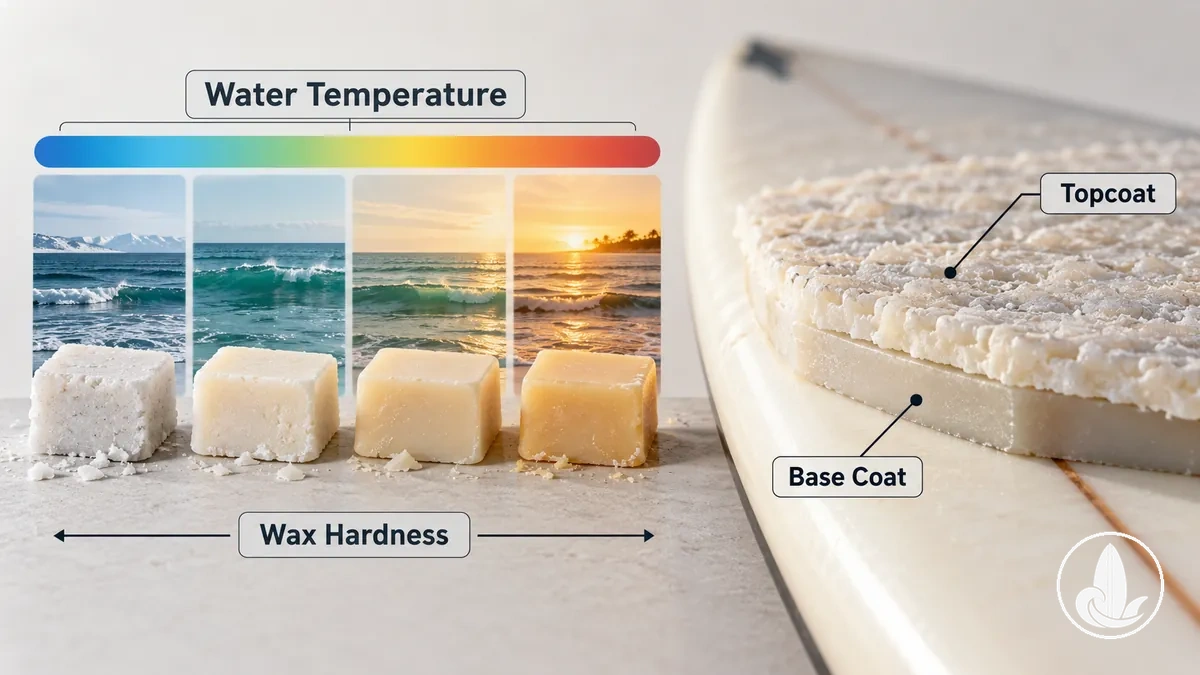
If the water changes enough to move outside the topcoat’s labelled range, switch to a topcoat formulated for the new conditions. The suitable relative hardness changes with that temperature grade rather than with brand preference alone.
Layer role is a separate decision: a base coat supplies a firmer foundation when that waxing approach is used, while the temperature-specific topcoat supplies the working surface tack. A base coat is therefore optional by waxing system, not a universal requirement.
Match Wax Hardness to Cold, Cool, Warm and Tropical Water
As intended water temperature rises, surf wax generally moves from softer cold-water grades toward harder warm and tropical grades. Cool-water wax sits between those ends of the relative hardness pattern.
This relationship helps each temperature-specific grade remain workable and tacky within its intended conditions, but category boundaries are formulation-specific and can overlap.

| Water category | Relative hardness | Expected behaviour |
|---|---|---|
| Cold water wax | Softest | Retains greater softness in colder water, supporting useful tack within its labelled range. |
| Cool water wax | Softer | Provides an intermediate balance of softness and firmness for its labelled cool-water conditions. |
| Warm water wax | Harder | Retains more firmness in warmer water, limiting excessive softening within its labelled range. |
| Tropical wax | Hardest | Uses greater relative hardness for hotter water, where a softer formulation could soften and smear excessively. |
The practical rule is directional rather than numerical: colder water → softer grade; warmer water → harder grade. Use the maker’s labelled range to choose the actual product grade.
Distinguish Base Coat from Temperature-Specific Topcoat
Base coat and topcoat describe different functions. A base coat is the firmer foundation layer when a layered waxing approach is used; a temperature-specific topcoat is the working surface that supplies tack for the current water conditions.

| Layer type | Relative hardness | Placement | Functional effect |
|---|---|---|---|
| Base coat | Harder wax formulated for the foundation role | On the deck beneath the topcoat when both layers are used | Creates a firmer textured foundation that can support the wax layer above. |
| Temperature-specific topcoat | Hardness matched to its labelled temperature grade | Working layer above the base coat when both layers are used | Provides the surface tack suited to the labelled water conditions. |
When both layers are used, the base coat establishes the textured foundation and the topcoat provides working tack. Do not infer that every surf wax system requires a base coat; follow the intended use of the products you are applying.
Apply Surf Wax for Even Coverage and Durable Traction
Apply surf wax with light repeated passes so the traction area develops distinct, even wax bumps instead of a thick smeared layer. The exact rubbing pattern can vary; the surface condition is the more useful endpoint.

- Prepare the deck: make sure the intended traction area is clean and suitably dry so the wax can contact the surface.
- Build the foundation when used: apply the base coat across the traction area if your waxing approach calls for one.
- Add the working layer: apply the temperature-appropriate topcoat over the intended traction area in the selected layer order.
- Build texture gradually: use light pressure and repeated passes rather than forcing a thick layer onto the deck.
- Stop at even texture: finish when the area has consistent wax bumps without smooth gaps or thick smeared buildup.
Excessive pressure can flatten or smear the wax instead of creating useful texture. Do not use a fixed number of passes as the endpoint; stop when the deck has consistent bumpy coverage across the area where traction is needed.
Use Enough Wax to Build Grip Without Excessive Buildup
Use enough wax to create consistent textured coverage across the traction area, not a fixed fraction of a bar. The amount changes with deck area, the wax already present, wax hardness and application conditions.

- Visible gaps: parts of the traction area still lack consistent wax coverage.
- Smooth low-grip zones: add wax where the deck still lacks the textured surface needed for traction.
- Consistent bumpy texture: stable wax bumps across the traction area indicate adequate coverage.
- Thick smeared buildup: stop adding wax; more material is creating thickness rather than useful texture.
Judge wax quantity by the surface state. Consistent bumps without gaps or heavy smearing are the practical stop condition.
Recognize When Surf Wax Needs Refreshing or Replacement
Refresh or replace surf wax according to grip and wax condition, not a universal time interval. The right action depends on whether the existing layer remains a usable traction surface.
Top up
Use a light top-up when the wax is still clean and serviceable but surface tack or texture has faded.
Clean
Address superficial contamination when the underlying wax layer remains textured and usable.
Full re-wax
Remove and rebuild the wax layer when embedded contamination, severe flattening or smearing, or excessive buildup prevents a consistent traction surface.
Change temperature grade
Replace the working wax with a grade suited to the new conditions when the water falls outside the current topcoat’s labelled range.
A major water-temperature change can create a mismatch even when the wax is relatively new. In that case, changing to the suitable temperature grade addresses the cause more directly than repeatedly topping up the mismatched wax.
Use Grip Loss, Contamination and Buildup as Re-Wax Cues
Grip loss, contamination, flattened texture, smearing and buildup are cues to reassess the wax layer, but none of them automatically means that a full re-wax is required. Match the action to how deeply the condition affects the existing traction surface.
- Grip loss: if the wax remains clean and textured, a top-up may be enough; reassess if traction stays poor.
- Contamination: clean superficial dirt, but choose a full re-wax when contamination is embedded through the wax layer.
- Flattened or smeared texture: top up when the foundation is still serviceable; fully re-wax when the degraded layer cannot support useful texture.
- Excessive buildup: stop adding wax and re-wax when accumulated material prevents a consistent traction surface.
The decision boundary is the condition of the existing layer: refresh a usable foundation; replace a foundation that is no longer usable.
Avoid Surf Wax Mistakes That Reduce Grip or Wax Life
The main surf wax mistakes are temperature mismatch, poor deck preparation, excessive pressure, uneven coverage and repeated buildup. Each can reduce traction for a different reason, so slipping should trigger a cause check rather than an automatic decision to add more wax.
| Mistake | Likely effect | Check | Corrective action |
|---|---|---|---|
| Temperature mismatch | A wrong wax grade can become too soft or too firm for the water conditions, reducing useful tack and contributing to slipping. | Compare the wax grade with its labelled water-temperature range and the current conditions. | Use a wax grade matched to the current water conditions. |
| Dirty or oily deck | Surface contamination can interfere with wax adhesion and contribute to wax loss or patchy coverage. | Check for dirt, oil or residue where the wax should adhere to the deck. | Address the contamination before applying fresh wax. |
| Excessive pressure | Heavy pressure can smear wax and flatten the texture needed for traction. | Look for flattened or smeared wax instead of distinct wax bumps. | Use lighter repeated passes when building wax texture. |
| Uneven coverage | Incomplete coverage can leave low-grip areas within the intended traction zone. | Check the traction area for gaps or smooth sections between textured wax. | Build textured coverage where the deck remains under-waxed. |
| Repeated buildup | Fresh wax over a degraded layer can add thickness without restoring a consistent traction surface. | Check whether the underlying wax is dirty, heavily flattened, smeared or excessively built up. | Reassess or replace the degraded layer instead of continuing to add wax. |
Check temperature fit, deck cleanliness, surface texture and coverage in that order. The corrective action should follow the failed condition: change grade for a temperature mismatch, clean contamination, use lighter passes for smearing, or build coverage only where the deck is genuinely under-waxed.